


2027 Chevrolet Bolt EV Range, Charging & Ownership Costs for Waynesboro Drivers
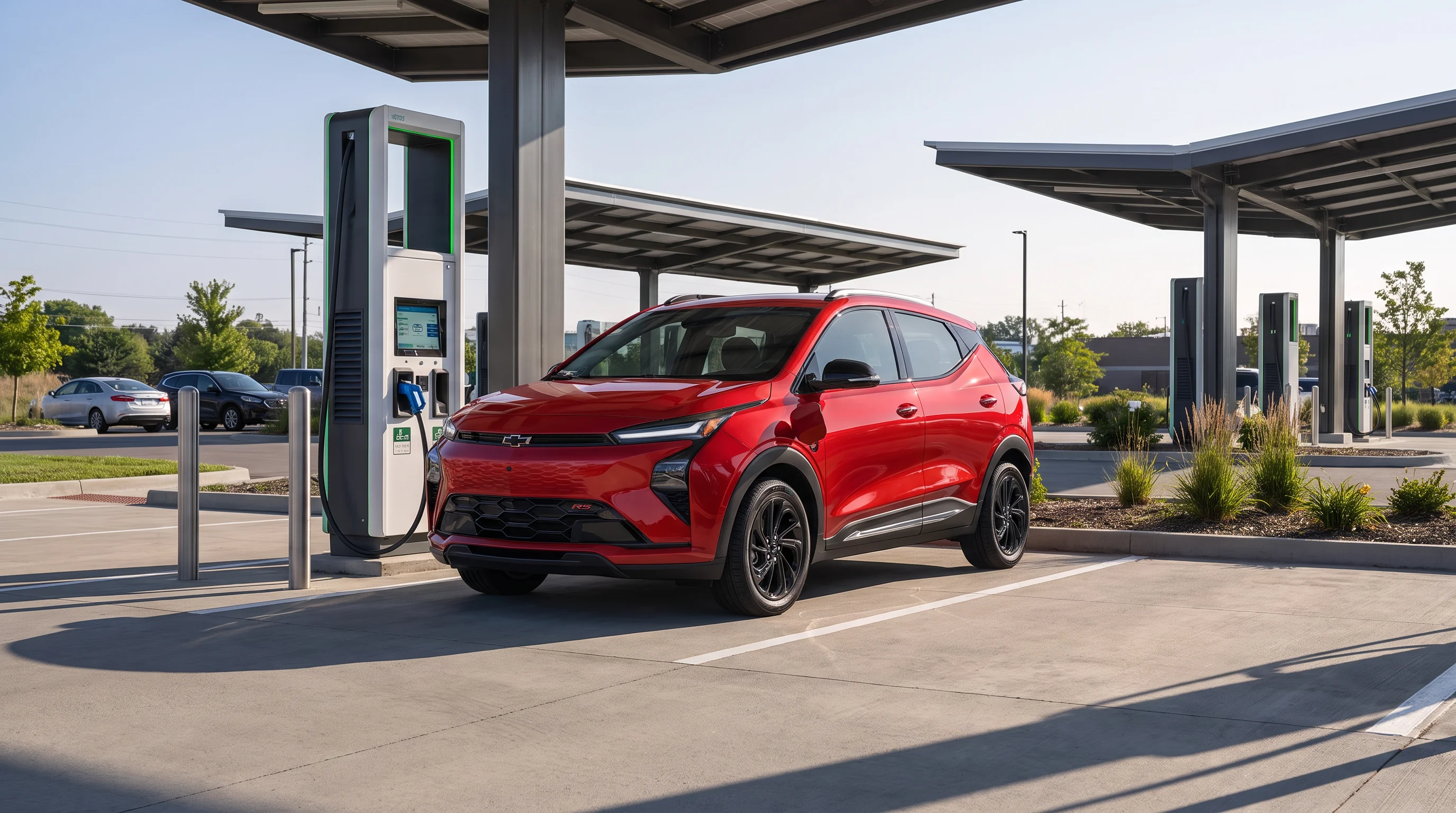
What Is the Estimated Driving Range of the 2027 Chevrolet Bolt EV?
Chevrolet rates the 2027 Chevrolet Bolt EV at an EPA-estimated 262 miles‡ of driving range on a full charge from its 65-kWh lithium iron phosphate battery pack. Both the LT and RS trims share the same battery, motor, and range rating, so the trim you choose does not change how far you can drive between charges.
The 2027 Bolt EV returns as a front-wheel-drive hatchback powered by a 210-horsepower electric motor producing 169 lb-ft of torque, a 10-horsepower increase over the previous-generation Bolt EV. Combined efficiency lands at an EPA-estimated 120 MPGe‡, broken out as an EPA-estimated 134 MPGe in the city and 106 MPGe on the highway.
Energy storage comes from lithium iron phosphate chemistry in prismatic can cells, paired with GM’s X76 electric drive unit, the same in-house drive unit now used across ten GM electric models. A blended regenerative braking system returns braking energy to the battery whether or not you engage One-Pedal Driving mode, and the 11-inch-diagonal driver information center keeps range and charge status in front of you.
2027 Chevrolet Bolt EV at a Glance
| Specification | 2027 Chevrolet Bolt EV |
|---|---|
| EPA-estimated range‡ | 262 miles |
| EPA-estimated combined efficiency‡ | 120 MPGe (134 city / 106 highway) |
| Battery | 65 kWh lithium iron phosphate, prismatic can cells |
| Motor | Single front permanent-magnet motor, X76 electric drive unit |
| Horsepower | 210 hp |
| Torque | 169 lb-ft |
| Drivetrain | Front-wheel drive |
| Charge port | Factory-integrated North American Charging Standard (NACS) |
| DC fast charging | Up to 150 kW — 10% to 80% in 25 minutes |
| Onboard AC charging | 11.5 kW |
| Battery warranty‖ | 8 years / 100,000 miles |
| Trims | LT and RS |
‡ EPA-estimated fuel economy figures are for comparison purposes only. Your actual mileage will vary depending on driving conditions, how you drive and maintain your vehicle, battery age/condition, and other factors.
‖ This information is provided for general educational purposes only and does not constitute legal advice. Warranty coverage depends on the specific terms of your vehicle’s warranty agreement. Consult your owner’s manual or a qualified legal professional for guidance on your individual situation.
The 2027 Bolt EV is available now at Chevrolet dealerships, and Chevrolet has described it as a limited-run model built for a single extended model year. If the Bolt EV is on your list, the window to buy one is finite.
At Buchanan Automotive Chevrolet, our team is ready to help Waynesboro drivers make the move to electric.
Cited Source: Chevrolet Pressroom — 2027 Chevrolet Bolt specifications — range, battery, motor, drive unit, charging, warranty, displays, limited-run status | FuelEconomy.gov — 2027 Chevrolet Bolt — EPA range and MPGe ratings
Federal EV Tax Credit Eligibility for the 2027 Chevrolet Bolt EV
No. The federal IRC §30D New Clean Vehicle Credit is not available to present-day buyers of the 2027 Chevrolet Bolt EV. Federal clean vehicle tax credit programs were terminated by legislation enacted on July 4, 2025, for all vehicles acquired after September 30, 2025, so purchases completed today do not qualify for the former $7,500 credit.
One narrow exception remains. Buyers who entered into a written binding purchase contract and made a payment, which the IRS defines to include a nominal down payment or a vehicle trade-in, on or before September 30, 2025, may still claim the credit when they take delivery.
Cited Source: IRS — Modification of sections 25C, 25D, 25E, 30C, 30D, 45L, 45W and 179D under Public Law 119-21 — credit termination and binding-contract exception | Congressional Research Service — Clean Vehicle Tax Credits (IF12600) — credit structure and repeal
Pennsylvania EV Costs and Incentives for Bolt EV Owners
Pennsylvania Alternative Fuel Vehicle Rebate
Pennsylvania’s Alternative Fuel Vehicle Rebate Program, administered by the Pennsylvania Department of Environmental Protection, is currently closed and is not accepting applications. When the program has been open, it offered a $3,000 rebate on battery electric vehicles, with an additional $1,000 available to applicants meeting low-income requirements. Eligibility has been limited by household income, restricted to a final vehicle purchase price of $45,000 or less, and applications had to be submitted within six months of purchase. Because amounts and funding windows are set annually, check the Department’s rebate page for current status before counting on state assistance.
Pennsylvania’s Annual Road User Charge
Pennsylvania EV owners should plan for a cost that applies right now. Under Act 85 of 2024, later amended by Act 149 and effective April 1, 2025, Pennsylvania charges electric vehicle owners an annual Road User Charge in place of fuel tax revenue. For 2026 the charge is $250 per year for battery electric vehicles and $63 for plug-in hybrids. Beginning in 2027 the amounts are adjusted annually for inflation.
| Pennsylvania EV Cost & Incentive Snapshot | Status as of October 2026 |
|---|---|
| Federal New Clean Vehicle Credit (§30D) | Terminated for vehicles acquired after September 30, 2025 |
| PA Alternative Fuel Vehicle Rebate | Closed — not accepting applications |
| AFV Rebate amount when open | $3,000 battery electric, plus $1,000 low-income |
| AFV Rebate vehicle price cap | $45,000 final purchase price |
| AFV Rebate application window | Within six months of purchase |
| PA Road User Charge — battery electric | $250 per year (2026) |
| PA Road User Charge — plug-in hybrid | $63 per year (2026) |
| Road User Charge after 2026 | Adjusted annually for inflation beginning 2027 |
For drivers across Franklin and Adams counties, including Waynesboro, Greencastle, Chambersburg, and Gettysburg, both sides of that ledger matter. Our team at Buchanan Automotive Chevrolet stays current on regional incentive changes so we can give you an accurate picture of what Bolt EV ownership actually costs.
Cited Source: Pennsylvania DEP — Alternative Fuel Vehicle Rebates for Consumers — program status, rebate amounts, eligibility | PennDOT — Road User Charge for Electric and Plug-In Hybrid Vehicles — Act 85 of 2024, annual amounts, inflation indexing
Home Level 2 Charging Setup and Installation Costs
What Your Home Electrical Setup Needs
Home Level 2 charging for the 2027 Chevrolet Bolt EV runs on a dedicated 240-volt circuit, and the size of that circuit determines how fast you charge. The Bolt EV’s onboard charging module is rated at 11.5 kW, and reaching that full rate requires a professionally installed 60-amp dedicated charge station. A smaller 240-volt circuit still works — it simply charges more slowly. At the full 11.5 kW rate, the Bolt EV adds roughly 40 miles of range per hour, enough to refill a nearly empty battery overnight.
| Charging Setup | Estimated Rate‡ |
|---|---|
| 120V household outlet (1.4 kW) | Approximately 4 miles of range per hour |
| 240V dual-level charge cord (7.7 kW) | Approximately 27 miles of range per hour |
| 240V home charge station (11.5 kW, 60-amp circuit) | Approximately 40 miles of range per hour |
| DC public fast charging (150 kW) | 10% to 80% in 25 minutes |
‡ EPA-estimated fuel economy figures are for comparison purposes only. Your actual mileage will vary depending on driving conditions, how you drive and maintain your vehicle, battery age/condition, and other factors.
What Installation Costs
Installation costs vary with your home’s electrical situation. Industry estimates for 2026 generally place a complete Level 2 installation between $800 and $2,700, covering the charging unit, licensed electrician labor, materials, and permitting. The distance between your panel and the charging location is usually the largest single variable, and most homes on modern 200-amp service can add a dedicated circuit without a full panel upgrade.
DC Fast Charging on the Road
The 2027 Bolt EV is Chevrolet’s first vehicle with a factory-integrated North American Charging Standard port. It supports DC fast charging up to 150 kW and goes from 10% to 80% charge in 25 minutes, more than 2.5 times faster than the previous-generation Bolt EV. The native NACS port connects directly to NACS fast-charging networks without an adapter, though CCS stations still require one.
Cited Source: Chevrolet Pressroom — 2027 Chevrolet Bolt specifications — charging rates, NACS port, DC fast-charge times, 60-amp home charging requirement | U.S. Department of Energy Alternative Fuels Data Center — Pennsylvania laws and incentives — current charging and utility programs. Installation cost ranges reflect aggregated 2026 industry estimates and vary by home.
2027 Bolt EV Battery Technology and Life Expectancy
The 2027 Chevrolet Bolt EV uses a lithium iron phosphate battery pack built in prismatic can cells and rated at 65 kWh. Chevrolet backs it with an 8-year/100,000-mile limited warranty‖ on battery coverage.
‖ This information is provided for general educational purposes only and does not constitute legal advice. Warranty coverage depends on the specific terms of your vehicle’s warranty agreement. Consult your owner’s manual or a qualified legal professional for guidance on your individual situation.
LFP chemistry carries real advantages over the nickel-manganese-cobalt chemistries used in many electric vehicles, including greater thermal stability, strong resistance to degradation from frequent full charges, and lower manufacturing cost. That full-charge tolerance is practical, not theoretical: Chevrolet recommends charging the Bolt EV to 100% regularly, because a full pack produces the fastest overall DC fast-charging speeds.
Battery longevity is better understood now than it was a few years ago. Geotab’s EV battery health study, drawn from more than 22,700 electric vehicles across 21 makes and models, found an average degradation rate of 2.3% per year, and projects that a typical pack still retains roughly 75% of its original capacity after about 13 years.
For drivers covering the agricultural back roads and rolling terrain around Quincy Township and the wider Waynesboro area, that durability translates into a vehicle that holds its usable range through years of daily driving.
Cited Source: Chevrolet Pressroom — 2027 Chevrolet Bolt specifications — battery chemistry, capacity, warranty | Geotab — EV Battery Health Study — real-world degradation rates across 22,700+ vehicles
How Does Cold Winter Weather Impact the 2027 Chevrolet Bolt EV Range?
Sustained sub-freezing temperatures temporarily reduce the driving range of any electric vehicle, commonly by an estimated 15% to 30%. Cold slows the chemical reactions inside lithium-based battery cells, and cabin heating draws additional energy that would otherwise go toward range. Large real-world studies place the average loss near 22% at freezing, with deeper losses as temperatures drop further.
The 2027 Bolt EV is better equipped for a Pennsylvania winter than the Bolt EV it replaces. Its climate system is GM Energy Recovery, a heat pump that handles active cabin and battery heating and cooling. The previous-generation Bolt EV used resistive heating instead, and fleet data shows that difference matters across a full winter of commuting.
| Cabin Heating System | Estimated Range Retained at Freezing‡ |
|---|---|
| Heat pump — including the 2027 Bolt EV | Approximately 83% |
| Resistive heating — including the previous-generation Bolt EV | Approximately 75% |
‡ EPA-estimated fuel economy figures are for comparison purposes only. Your actual mileage will vary depending on driving conditions, how you drive and maintain your vehicle, battery age/condition, and other factors.
You can reduce winter range loss further by preconditioning the cabin and battery while the Bolt EV is still plugged in, so the energy comes from the grid rather than the pack. Available heated front seats and an available heated steering wheel also warm you more efficiently than cabin air alone, which conserves range on cold mornings.
Cited Source: Chevrolet Pressroom — 2027 Chevrolet Bolt specifications — GM Energy Recovery heat pump, available heated seats and steering wheel | Cold-weather retention figures reflect Recurrent’s winter range study of more than 30,000 connected electric vehicles.
Common Questions About 2027 Chevrolet Bolt EV Ownership
How fast does the 2027 Chevrolet Bolt EV charge at public DC fast chargers?
The 2027 Bolt EV supports DC fast charging up to 150 kW, taking the 65-kWh battery from 10% to 80% charge in 25 minutes under optimal conditions. That is more than 2.5 times faster than the previous-generation Bolt EV.
Does the 2027 Chevrolet Bolt EV come with a North American Charging Standard port?
Yes. The 2027 Bolt EV is the first Chevrolet with a factory-integrated NACS charge port, connecting directly to NACS fast-charging networks without an adapter. Charging at a CCS station still requires an adapter.
How should I prepare my home electrical panel for a Level 2 EV charger?
Have a licensed electrician evaluate your main breaker panel before installing a charging station. Reaching the Bolt EV’s full 11.5 kW home charging rate requires a professionally installed 60-amp dedicated 240-volt circuit, and your electrician can confirm whether your existing service supports that load.
Researching other Chevrolet electric models? Explore the Chevrolet Equinox EV or browse the full Chevrolet Model Showroom.
Next Steps for Your Chevrolet EV Journey
Whether you are comparing range figures, pricing a home charging setup, or weighing what Pennsylvania EV ownership actually costs, our team at Buchanan Automotive Chevrolet is here to help. The 2027 Bolt EV is available now, and as a limited-run model it will not be in production indefinitely.
Visit our Waynesboro dealership at 1035 E Main St, browse current availability online, or call our sales specialists at 717-762-3141 to arrange a look at the 2027 Chevrolet Bolt EV in person.
Disclaimers
‡ EPA-estimated fuel economy figures are for comparison purposes only. Your actual mileage will vary depending on driving conditions, how you drive and maintain your vehicle, battery age/condition, and other factors.
‖ This information is provided for general educational purposes only and does not constitute legal advice. Warranty coverage depends on the specific terms of your vehicle’s warranty agreement. Consult your owner’s manual or a qualified legal professional for guidance on your individual situation.
