


What Is the Difference Between GVWR and GCWR on a Chevy Truck?
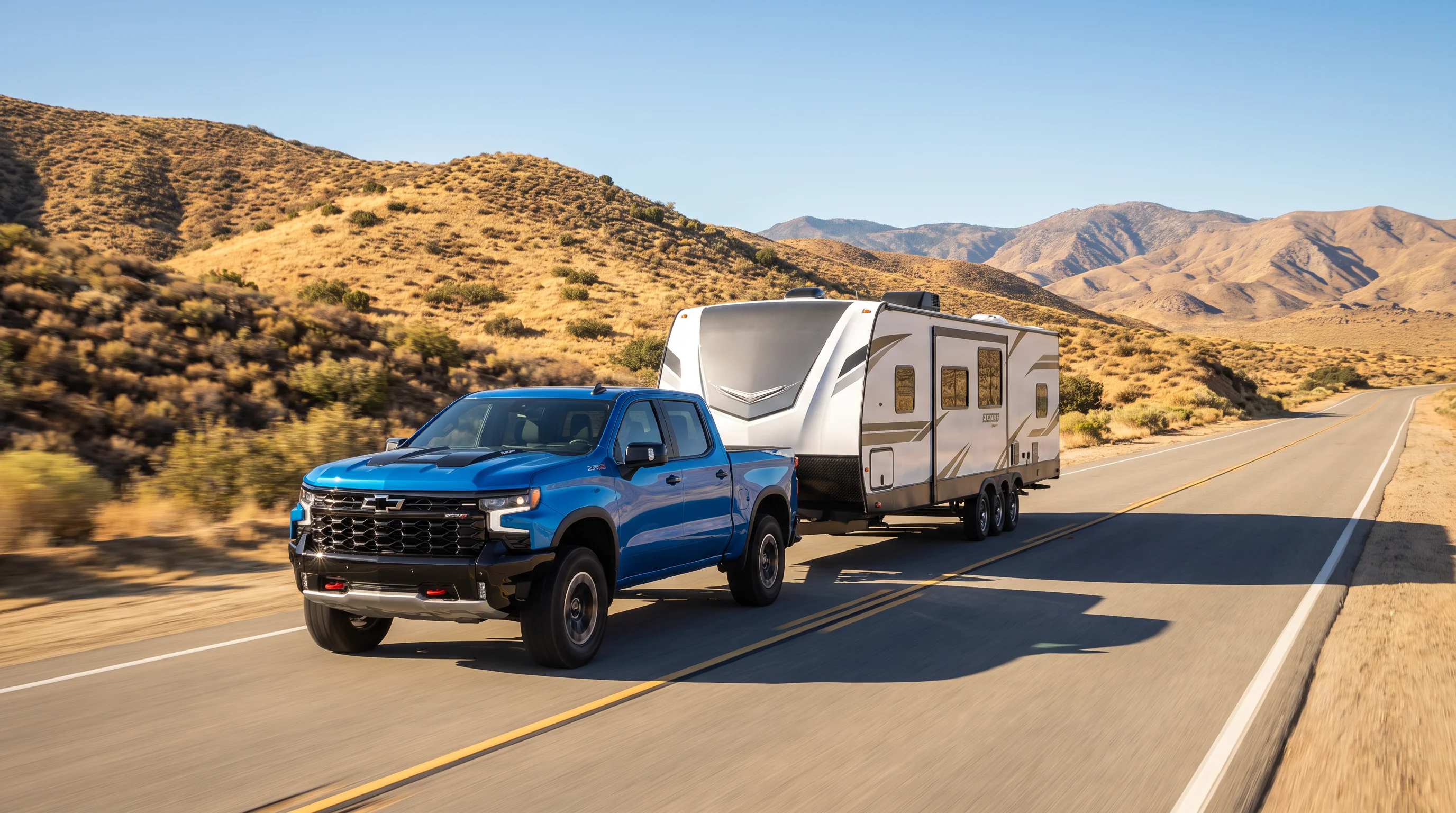
Gross Vehicle Weight Rating (GVWR) is the maximum allowable weight of a Chevrolet truck when fully loaded on its own four tires, including the vehicle, passengers, cab cargo, bed loads, and trailer tongue weight. Gross Combined Weight Rating (GCWR) is the maximum weight of the entire combined setup: the fully loaded truck plus the fully loaded trailer and everything inside it, as defined in Chevrolet’s 2026 Trailering Guide.
GVWR vs. GCWR at a Glance
| Rating | What It Limits | What It Includes | What It Protects |
|---|---|---|---|
| GVWR | The weight bearing down on the truck itself | Truck, passengers, cab cargo, bed loads, and trailer tongue weight | Suspension, frame, axles, tires, and brakes |
| GCWR | The weight of the truck and trailer combined | Fully loaded truck plus fully loaded trailer | Engine, transmission, cooling system, drivetrain, and braking |
Understanding the distinction is essential to operating a pickup safely and legally. GVWR focuses strictly on the weight bearing down on the truck’s suspension, frame, and axles. Exceeding GVWR can overload the axles and strain braking and suspension components whether or not a trailer is attached. GCWR reflects the total pulling and stopping burden placed on the engine, transmission, cooling system, and drivetrain. Whether you tow around Waynesboro or across Quincy Township, staying within both ratings helps protect your drivetrain and brakes.
Quick Math Examples
The examples below use hypothetical figures to show how each rating works.
| Rating | Example Limit | Truck Weight | Remaining Capacity |
|---|---|---|---|
| GVWR | 7,100 lbs | 5,010 lbs (curb weight) | 2,090 lbs for occupants, bed cargo, and tongue weight |
| GCWR | 19,000 lbs | 5,500 lbs (loaded with gear and passengers) | 13,500 lbs maximum trailer weight |
Maximum towing and payload capacity figures are based on properly equipped vehicles and vary by configuration. Do not exceed any weight rating. See your owner’s manual and the vehicle’s door-jamb label for specific capacities.
Why You Need to Check Both Ratings
Staying below your GCWR does not automatically mean you are under your GVWR. A heavy load in the bed combined with high tongue weight can push a truck over its GVWR even when the trailer is well under the GCWR limit. If you have questions about the ratings on a specific truck’s door jamb label, our truck specialists are happy to help at our Waynesboro showroom or by phone at (717) 762-3141.
What Is Payload Capacity on a Chevy Truck and How Is It Calculated?
Payload capacity is the maximum total weight a Chevrolet pickup can carry in its cab and bed, plus the downward tongue weight of a trailer. It is calculated by subtracting the truck’s curb weight from its GVWR, a standard industry formula.
Payload Capacity = GVWR − Curb Weight
Every passenger, piece of equipment, aftermarket accessory, and tool you add consumes available payload. Higher trim levels with more standard equipment weigh more, so they typically have less payload than a lighter, more basic configuration with the same cab and bed.
Payload Terms to Know
| Term | What It Means |
|---|---|
| Curb Weight | The weight of the truck with full fuel and standard equipment, but no passengers or cargo |
| GVWR | The maximum certified operating weight of the vehicle itself |
| Occupant & Cargo Weight | The combined weight of the driver, passengers, tools, gear, and bed accessories |
| Trailer Tongue Weight | The downward force on the hitch ball, which counts directly against payload |
How to Find the Payload Left for Towing
- Start with your truck’s rated payload.
- Subtract the weight of all passengers, bed cargo, tools, and hitch hardware.
- What remains is the maximum tongue weight you can add.
Maximum towing and payload capacity figures are based on properly equipped vehicles and vary by configuration. Do not exceed any weight rating. See your owner’s manual and the vehicle’s door-jamb label for specific capacities.
Load Placement Matters
Weight placed forward of the rear axle helps balance the load between the front and rear Gross Axle Weight Ratings (GAWR), which is why loading experts recommend placing heavy cargo as far forward in the bed as possible. Drivers looking to maximize hauling capability can explore our new Chevrolet Silverado 1500 inventory to compare cab configurations and bed lengths.
What Is Tongue Weight and What Percentage of Trailer Weight Should It Be?
Tongue weight is the downward force the loaded trailer’s tongue places on the tow vehicle’s hitch ball. According to Chevrolet’s 2026 Trailering Guide, conventional trailers should carry 10% to 15% of the loaded trailer weight on the tongue, and gooseneck or fifth-wheel trailers should carry 15% to 25%.
Tongue Weight Targets by Trailer Type
| Trailer Type | Target Tongue (Kingpin) Weight | Why |
|---|---|---|
| Conventional Bumper-Pull | 10% – 15% of loaded trailer weight | Connects behind the rear bumper |
| Gooseneck / Fifth-Wheel | 15% – 25% of loaded trailer weight | Connection point sits near the truck’s rear axle |
Too Little vs. Too Much Tongue Weight
Proper tongue weight is critical to vehicle control and stability.
| Condition | What Happens |
|---|---|
| Below 10% | The trailer becomes tail-heavy and is prone to sway at highway speeds |
| Above 15% | Extra downward force loads the truck’s rear axle and can push it past its Rear Gross Axle Weight Rating (RGAWR) or GVWR |
Owners stepping up to fifth-wheel towing can learn more about Chevrolet’s heavy-duty Silverado HD lineup.
Worked Example: 7,000-lb Trailer
Whether you’re hauling livestock or a camper out of Antrim Township, verifying tongue weight helps prevent sway. Here’s the target range for a fully loaded 7,000-lb tandem-axle trailer:
| Loaded Trailer Weight | 10% Tongue Weight | 15% Tongue Weight |
|---|---|---|
| 7,000 lbs | 700 lbs | 1,050 lbs |
Maximum towing and payload capacity figures are based on properly equipped vehicles and vary by configuration. Do not exceed any weight rating. See your owner’s manual and the vehicle’s door-jamb label for specific capacities.
That weight rests directly on your hitch, reducing your truck’s remaining payload pound for pound. Shoppers looking at pre-owned pickups for recreational towing can browse our current pre-owned inventory to find trucks equipped with factory trailering equipment.
What Is the Chevy Max Trailering Package, and When Is a Weight-Distributing Hitch Required?
The Chevrolet Max Trailering Package upgrades axle, suspension, and cooling hardware to raise the Silverado 1500’s tow ratings, and Chevrolet requires a weight-distributing hitch with sway control for conventional trailers over 5,000 lbs.
What’s in the Max Trailering Package
The Max Trailering Package is designed for drivers who need more capability without stepping up to a heavy-duty truck. It raises conventional tow ratings, as well as gooseneck and fifth-wheel ratings when a frame-mounted hitch is installed. On the 2026 Silverado 1500, GM’s order guide lists the package contents as:
| Component | 2026 Silverado 1500 Specification |
|---|---|
| Rear axle ratio | 3.42 with the 5.3L or 6.2L V8; 3.73 with the Duramax 3.0L Turbo-Diesel |
| Rear axle | 9.76-inch |
| Rear springs | Heavier-duty, with an increased Rear Gross Axle Weight Rating |
| Shocks | Revised tuning for increased control |
| Cooling | Enhanced cooling radiator |
| Alternator | 220-amp |
In the 2026 order guide, the integrated trailer brake controller and automatic locking rear differential are listed separately from the Max Trailering Package, so check a specific truck’s window sticker to confirm which features it has. To see which models include a factory brake controller, read our guide to Silverado models with an integrated trailer brake controller.
When Is a Weight-Distributing Hitch Required?
A weight-distributing hitch becomes essential once a conventional trailer crosses 5,000 lbs. A standard ball hitch acts as a lever behind the rear axle, pressing down on the rear suspension and lifting weight off the front wheels. A weight-distributing hitch uses adjustable spring bars to shift some of that hitch weight forward to the truck’s front axle and rearward to the trailer’s axles.
| Conventional Trailer Weight | Hitch Requirement |
|---|---|
| 5,000 lbs or less | Weight-carrying hitch permitted |
| Over 5,000 lbs | Weight-distributing hitch and sway control required |
Maximum towing and payload capacity figures are based on properly equipped vehicles and vary by configuration. Do not exceed any weight rating. See your owner’s manual and the vehicle’s door-jamb label for specific capacities.
These limits come from Chevrolet’s 2026 Trailering Guide, which also notes that some weight-carrying setups are limited to 600 lbs of tongue weight, so confirm the exact limits for your truck in your owner’s manual. Leveling the truck with spring bars restores load to the front axle, which improves steering response, preserves front braking, and keeps handling predictable under heavy loads.
Why Do Published Towing Charts Differ From Your Truck’s Door Jamb Label?
Published towing figures are maximums for specific, ideally equipped configurations, while the Trailering Information Label on your truck’s driver-side door jamb lists ratings for your individual vehicle as built.
Headline Ratings vs. Your Truck
Chevrolet advertises the following maximums for the 2026 Silverado 1500. Reaching them requires very specific builds:
| Rating | Max Available | Required Configuration |
|---|---|---|
| Conventional towing | 13,300 lbs | 2WD Double Cab Standard Bed with the Duramax 3.0L Turbo-Diesel, Max Trailering Package, and 20-inch wheels |
| Payload | 2,260 lbs | 2WD Regular Cab Long Bed with the TurboMax engine |
Maximum towing and payload capacity figures are based on properly equipped vehicles and vary by configuration. Do not exceed any weight rating. See your owner’s manual and the vehicle’s door-jamb label for specific capacities.
For a full breakdown of which configurations tow the most, see our Silverado 1500 towing capacity guide.
Options That Add Curb Weight
Factory options add curb weight and reduce net payload, including:
- Leather upholstery
- Power running boards
- A sunroof
- Four-wheel drive
- Skid plates
- Larger wheels
Because payload limits how much tongue weight you can carry, a well-optioned trim typically has lower real-world payload and towing headroom than a basic Work Truck with the same engine.
What’s on the Trailering Information Label
To find your truck’s true ratings, open the driver’s door and check the Trailering Information Label. According to Chevrolet, it lists:
| Label Item | What It Tells You |
|---|---|
| GVWR | Gross Vehicle Weight Rating for your truck |
| GCWR | Gross Combination Weight Rating for your truck |
| Rear GAWR | Rear Gross Axle Weight Rating |
| Maximum Payload | The weight capacity for occupants, cargo, and tongue weight |
| Maximum Tongue Weight | The maximum trailer tongue load allowed |
| Curb Weight | The weight of your truck as built |
If you want help reading your truck’s label before a long haul, give our truck specialists a call.
Common Questions About Chevy Truck Towing and Payload Ratings
Can you exceed GVWR if your total trailer weight is under the maximum towing capacity?
No. You should never exceed your truck’s GVWR, even if your trailer weighs well below the published towing capacity. GVWR governs the total weight resting on the truck’s tires, while towing capacity governs the pulled load. Heavy passengers, bed cargo, or high tongue weight can push a truck over its GVWR while the trailer stays within GCWR limits. You must stay under every rating at the same time.
Does trailer tongue weight count against a Chevy truck’s payload capacity?
Yes. Tongue weight rests on the rear hitch and presses down on the rear axle just like cargo in the bed. When calculating payload for passengers and equipment, subtract the measured tongue weight from the maximum payload on your door jamb label.
How do optional axle ratios impact a truck’s GCWR and towing limits?
Axle ratio changes the mechanical advantage between the driveshaft and the rear wheels. According to Chevrolet, a higher (numerically larger) axle ratio such as 3.42 or 3.73 generally offers higher trailer weight ratings and quicker acceleration, with less fuel efficiency. That’s why the Max Trailering Package pairs a shorter axle ratio with higher GCWR and towing ratings.
Maximum towing and payload capacity figures are based on properly equipped vehicles and vary by configuration. Do not exceed any weight rating. See your owner’s manual and the vehicle’s door-jamb label for specific capacities.
How does the in-vehicle trailering app assist with towing safety?
The available Chevrolet in-vehicle trailering app offers custom trailer profiles, a pre-departure checklist, a trailer light test, and trailer tire pressure and temperature monitoring with available sensors. Paired with up to 14 available camera views, it helps drivers keep an eye on the truck, trailer, and surroundings. One of those views, Transparent Trailer View, requires an available Chevrolet Accessory camera.
Driver-assist and safety systems are supplemental aids and are not a substitute for safe, attentive driving. Their effectiveness depends on weather, road, and traffic conditions and other factors. Always obey traffic laws and stay attentive to the road. See your owner’s manual for system details and limitations.
The axle ratio guidance and trailering app and camera details above are drawn from Chevrolet’s 2026 Trailering Guide.
Master Your Chevy Truck Towing Setup
Configuring a Chevrolet truck for towing comes down to a few checks that help ensure stable handling and long-term reliability:
Your Towing Setup Checklist
- Match trailer weights to your truck’s door jamb label, axle ratings, and hitch limits.
- Calculate your payload properly, including tongue weight.
- Keep tongue weight at 10% to 15% of the loaded trailer weight.
- Use a weight-distributing hitch with sway control for trailers over 5,000 lbs.
2026 Silverado 1500 Engine Options at a Glance
Engine choice, along with axle ratio, cab, bed, and drivetrain, determines each configuration’s GCWR and tow rating. Here are the four 2026 Silverado 1500 engines:
| Engine | Horsepower | Torque | Transmission | Drivetrain |
|---|---|---|---|---|
| TurboMax 2.7L | 310 hp | 430 lb-ft | 8-speed automatic | 2WD / 4WD |
| 5.3L EcoTec3 V8 | 355 hp | 383 lb-ft | 10-speed automatic | 2WD / 4WD |
| 6.2L EcoTec3 V8 | 420 hp | 460 lb-ft | 10-speed automatic | 4WD |
| Duramax 3.0L Turbo-Diesel | 305 hp | 495 lb-ft | 10-speed automatic | 2WD / 4WD |
Get Help Choosing the Right Setup
Our team at Buchanan Automotive Chevrolet is here to help you choose the right engine, axle ratio, cab style, and trailering package for your equipment. Visit our showroom at 1035 E Main St, Waynesboro, PA 17268 to explore our lineup in person, or call our truck sales team at (717) 762-3141.
Disclaimers
Maximum towing and payload capacity figures are based on properly equipped vehicles and vary by configuration. Do not exceed any weight rating. See your owner’s manual and the vehicle’s door-jamb label for specific capacities.
Driver-assist and safety systems are supplemental aids and are not a substitute for safe, attentive driving. Their effectiveness depends on weather, road, and traffic conditions and other factors. Always obey traffic laws and stay attentive to the road. See your owner’s manual for system details and limitations.

0 comment(s) so far on What Is the Difference Between GVWR and GCWR on a Chevy Truck?